How to Source Tactical Pants Wholesale: A Complete Guide for Distributors
Many wholesale buyers encounter the same problem after their first tactical pants order: the fabric weight was wrong, the delivery was three weeks late, or the supplier turned out to be a trading company with no real production control. These are avoidable mistakes — and they almost always trace back to the sourcing stage, not the production stage.
The global market for tactical pants wholesale spans military contractors, law enforcement distributors, security uniform suppliers, outdoor retailers, and private-label brands across North America, Europe, Africa, the Middle East, and Southeast Asia. Demand is stable and growing. The challenge is not finding suppliers — it is identifying the right manufacturing partner who can deliver consistent quality, support bulk production, and accommodate customization requirements without compromising lead times.
This guide covers the full sourcing process: product types, fabric and construction standards, manufacturer evaluation criteria, sourcing models, and the key parameters every wholesale buyer should confirm before placing a bulk order.
1. What Types of Tactical Pants Are Available for Wholesale?
Tactical pants is a broad category. Before approaching suppliers, it helps to identify which product type fits your target market and end user — as construction standards, fabric choices, and price points vary significantly across styles.
Cargo Tactical Pants
The highest-volume wholesale category globally. Cargo tactical pants feature multiple utility pockets, reinforced knees, and a durable construction suited to extended field use. They are sourced by security companies, outdoor retailers, military contractors, and distributors supplying active lifestyle markets. Fabric is typically 65/35 polyester-cotton ripstop or cotton canvas, in weights ranging from 180gsm to 280gsm.
Ripstop Tactical Pants
Ripstop fabric uses a reinforced grid weave that resists tearing under stress — making ripstop tactical pants the standard for military and law enforcement supply contracts. They are lightweight, breathable, and highly durable, and are the preferred format for buyers sourcing for defense programs or tactical retail in North America and Europe. Common fabric specs are 65/35 NYCO ripstop or 100% nylon ripstop at 180–210gsm.
Stretch / Flex Tactical Pants
Stretch tactical pants incorporate elastane or bi-stretch panels for improved mobility during dynamic movement. Increasingly specified by law enforcement, close-protection security, and urban tactical buyers, particularly in European markets where comfort during extended wear is prioritized alongside functional design.
Work & Utility Pants
A category adjacent to tactical pants, work and utility pants share similar construction principles — reinforced pockets, durable waistbands, abrasion-resistant fabric — but are positioned for industrial, construction, and facilities management buyers rather than military or security end users. Many factories supply both categories from the same production lines.
Regional preference note: North American buyers typically specify ripstop durability and MOLLE-compatible pocket layouts. European buyers favor lightweight stretch fabrics with a cleaner silhouette. African and Middle Eastern security buyers prioritize heat resistance, high-durability fabric, and neutral colorways such as khaki and tan.
2. Key Fabric and Construction Standards for Bulk Orders
Fabric and construction quality determine product durability in the field — and directly affect whether buyers return for repeat orders. When reviewing samples or discussing specifications with a potential supplier, the following criteria should be part of every evaluation.| Fabric Type | Composition | Key Benefit | Best For |
|---|---|---|---|
| 65/35 Poly-Cotton Ripstop | 65/35 Poly-Cotton Ripstop | Balanced durability and breathability | Military / Security / Retail |
| 100% Nylon Ripstop | 100% Nylon | Lightweight, high abrasion resistance | Tactical / Law Enforcement |
| Stretch Ripstop | Poly-Cotton + Elastane | Mobility and comfort | Security / Urban Use |
| Cotton Canvas | 100% Cotton | Heavy duty, natural feel | Work / Utility Pants |
| Cordura Nylon | High-tenacity Nylon | Maximum durability | Extreme-duty programs |
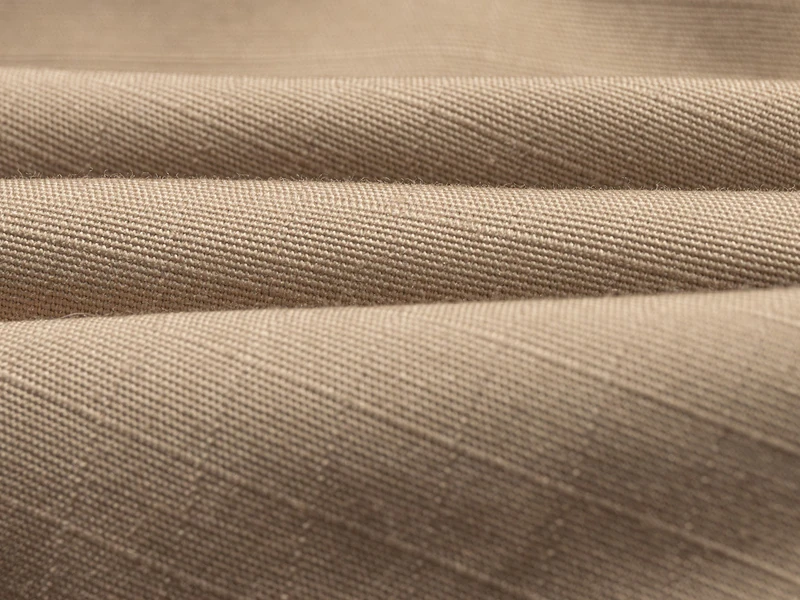
Beyond fabric selection, the following construction details are the most reliable indicators of professional-grade quality in tactical pants:
- Reinforced knee panels or knee pad pockets (double-layer fabric or Cordura inserts)
- Bar-tacked stress points at pocket corners, crotch seam, and belt loops
- YKK or equivalent-grade zippers on cargo pockets and fly
- Adjustable waistband with internal elastic or D-ring belt loops
- Flat-felled or French seams at high-stress points for enhanced durability
- Pre-shrunk fabric to prevent size variation after repeated washing
Buyer tip: Always request a wash test (minimum 20 cycles) and seam strength test with your pre-production sample. These two tests reveal more about long-term durability than any specification sheet or product description.
3. How to Evaluate a Tactical Pants Manufacturer
Not every supplier presenting as a tactical pants manufacturer operates a production facility. The distinction between a direct factory and a trading company has material consequences for pricing, customization capability, and quality control — particularly on bulk orders.
Factory vs. Trading Company
A direct manufacturer controls the full production process in-house: pattern development, fabric cutting, sewing, inline quality inspection, finishing, and packing. A trading company sources from third-party factories and adds a markup. For wholesale buyers placing bulk orders, working directly with a factory typically means better unit pricing, faster resolution of production issues, and more reliable OEM customization outcomes.
The clearest way to determine whether a supplier is a factory or trading company is to request a factory audit or ask for specific production data: monthly capacity by garment type, number of production lines, and lead times for new style development. Factories can answer these questions precisely. Trading companies typically cannot.
When evaluating a tactical pants manufacturer, assess these dimensions:
- Production capacity: Production capacity: What is their monthly output for tactical pants specifically? Can they scale to meet your program volume without subcontracting?
- Certifications: Certifications: ISO 9001 (quality management system) and BSCI or SEDEX (social compliance) are baseline credentials for export-oriented garment factories.
- Sampling capability: Sampling capability: A well-organized factory development team should be able to turn around a sample from an approved Tech Pack within 7–15 business days. Slow sampling is often a sign of disorganized pattern rooms or outsourced development.
- QC process: QC process: Does the factory conduct inline inspection during production and end-of-line AQL sampling? Are formal inspection reports provided? Ask to see a completed QC report from a recent order.
- Export track record: Export track record: How many countries does the factory export to, and for how long? Factories with multi-market export experience are more familiar with labeling compliance, customs documentation, and packing standards.
- Communication: Communication: Is there a dedicated merchandiser or account manager handling your inquiry? Response accuracy and speed in the pre-order phase is a reliable predictor of how production communication will go once an order is placed.
Beyond these standard criteria, tactical apparel sourcing has three industry-specific evaluation points that general procurement guides rarely mention:
Camouflage Pattern Licensing
Commercial camouflage patterns such as MultiCam, Kryptek, and A-TACS are protected by intellectual property rights. A manufacturer producing garments in these patterns must hold a valid licensing agreement with the pattern owner — or be able to demonstrate that the buyer’s own license covers production. Buyers sourcing tactical pants in commercial camo patterns should request written confirmation of licensing status before placing an order. Unlicensed production creates import compliance risk, particularly for buyers selling into the US and European markets.
Military Standard Compliance Capability
Buyers supplying government, defense, or institutional security programs often require products that meet specific performance standards — such as MIL-DTL-44047 (military trousers), NFPA 2112 (flame resistance), or NIJ standards for ballistic-adjacent applications. Not every tactical pants factory has experience producing to these specifications. Buyers with program-level requirements should ask directly whether the factory has produced to relevant military or institutional standards, and whether they can provide third-party test reports (SGS, Bureau Veritas, Intertek).
Colorfastness and Wash Standards
Tactical pants in operational use are washed frequently and exposed to UV, abrasion, and chemicals. Colorfastness — the ability of the dye to retain its appearance after repeated washing and exposure — is a critical quality parameter that is often overlooked at the sampling stage. A capable manufacturer should be able to provide colorfastness ratings to ISO 105 or AATCC standards for each colorway they produce. This is especially important for buyers sourcing in specific military color standards such as Coyote Brown (PMS 7503C) or Ranger Green (PMS 412C), where color consistency across production runs is a contractual requirement.
4. Sourcing Models, MOQ, and Customization Options
Wholesale buyers of tactical pants typically operate under one of two sourcing models. Understanding which model fits your business will determine the type of supplier relationship you need — and the production parameters you should negotiate upfront.
| OEM / Custom Production | Ready Stock | |
|---|---|---|
| MOQ | 500 – 1,000 pcs per style | From 20 pcs |
| Lead Time | 45 – 90 days | Ships within days |
| Customization | Full: fabric, color, cut, logo, labeling | Fixed styles, limited options |
| Unit Pricing | Lower at volume | Higher, no tooling cost |
| Best For | Brands, program supply, private label | Small B2B buyers, quick restocks |
| Commitment | Longer planning cycle, requires specs | Low commitment, fast entry |
For buyers with established demand — distributors running seasonal stock, security companies with annual uniform programs, or brands building a private-label product line — OEM production delivers better unit economics, stronger brand control, and more stable long-term supply. For buyers entering a new market or needing to fulfill orders quickly without a high upfront commitment, Ready Stock provides immediate access to core styles.
Customization Options in OEM Production
A capable OEM tactical pants manufacturer should be able to accommodate the following without requiring the buyer to source components separately:
- Colorway: standard military colors (Coyote Brown, Ranger Green, Black, Khaki, MultiCam) or custom dye-to-match from a Pantone or RAL reference
- Fabric: choice of ripstop weight (180–280gsm), stretch content, and functional coatings (DWR water repellency, IR-reflective treatment)
- Embroidery: flag patches, rank insignia, unit identifiers, brand logos
- Printing: screen print or heat transfer for care labels, size markings, or brand graphics
- Labeling: custom woven main labels, size labels, hangtags, and packing instructions
- Hardware and pocket layout: MOLLE webbing, D-rings, knee pad pockets, hidden waistband zip pockets, cargo pocket configurations
Lead time reference: Sample / prototype: 7–15 business days from approved Tech Pack. Bulk production: 45–75 days from sample approval and deposit receipt. Rush production timelines should be confirmed with the factory before the order is placed, as availability depends on production scheduling.
5. Why Source Tactical Pants from a China-Based OEM Factory?
China remains the dominant sourcing origin for wholesale tactical pants globally — not primarily because of price, but because of the depth and integration of the supply chain. Buyers sourcing from Chinese OEM factories for tactical apparel benefit from several structural advantages:
- Vertically integrated supply chains: fabric mills, ripstop weaving facilities, trim suppliers, zipper and hardware manufacturers, and garment factories operate in close proximity, reducing both lead times and material sourcing costs.
- Production scalability: established factories can handle pilot orders of a few hundred pieces and scale to program-level volumes without quality degradation or subcontracting risk.
- Technical manufacturing depth: decades of experience producing to military and commercial specifications, including MIL-SPEC standards, European EN standards, and institutional compliance requirements.
- Export infrastructure: established relationships with freight forwarders, customs brokers, and third-party inspection agencies for sea freight, air freight, and DDP delivery to all major markets.
For buyers in specific regions, the following summarizes typical sourcing requirements and customization priorities:
| Market | Typical Requirement | Common Customization |
|---|---|---|
| USA / Canada | Ripstop, MOLLE-compatible, MIL-compatible specs | US sizing, custom branding, camo licensing |
| UK / Europe | Lightweight stretch, EN compliance where applicable | EU sizing, eco-friendly labels, DWR finish |
| Africa (W & E) | High durability, heat resistance, neutral colorways | Embroidered logos, khaki / tan tones, DDP |
| Middle East | Breathable fabric, desert colors, high-durability | Arabic labeling option, DDP, tan / multicam |
| Southeast Asia | Lightweight, moisture-wicking, tropical conditions | Regional sizing, fast turnaround, OEM label |
6. FAQ: Common Questions from Wholesale Buyers
Q1:What is the minimum order quantity for tactical pants wholesale?
A: MOQ depends on the sourcing model. For OEM custom production, the typical MOQ is 500–1,000 pieces per style, varying with fabric complexity and construction. For Ready Stock programs, MOQ starts from 20 pieces. If a supplier offers full OEM production at an MOQ of 50–100 pieces, it is worth confirming whether they are operating as a direct factory or sourcing through a third party.
Q2: Can I customize the fabric, color, and logo on tactical pants?
A: Yes, through OEM production. Customization scope typically includes fabric composition and weight, colorway (standard military colors or custom dye-to-match from a Pantone reference), cut and pocket configuration, embroidery, woven labels, and packing. Buyers with a Tech Pack can submit it directly; buyers without one can work with the factory’s development team to define specifications from reference samples or design briefs.
Q3: How long does it take to receive a sample of tactical pants?
A: Standard sample lead time is 7–15 business days from receipt of an approved specification sheet or Tech Pack. To minimize revision rounds, all key details — fabric, colorway, hardware spec, size — should be aligned before the sample is requested. A second sample (counter-sample) is typically required if significant changes are made after the first review.
Q4: What certifications should a tactical pants manufacturer have?
A: ISO 9001 and BSCI or SEDEX are baseline credentials for export-oriented factories. For buyers supplying government or institutional programs, it is worth asking whether the factory has produced to applicable military standards (e.g. MIL-DTL-44047) and whether they can provide third-party test reports from SGS, Bureau Veritas, or Intertek. Colorfastness testing to ISO 105 or AATCC standards should also be available for any color-critical program.
Q5: Are tactical pants sourced from China suitable for resale in the US and European markets?
A: Yes — provided the factory has demonstrated export experience in those markets. The key compliance requirements are: correct origin labeling (country of origin, fiber content, care instructions in the target market language), adherence to any applicable import standards, and consistent quality across production runs. Factories with a verifiable track record of exporting to the US or EU present significantly lower compliance risk than those without.
Q6: What is the difference between cargo pants and tactical pants?
A: Cargo pants is a broad garment category defined by large side cargo pockets. Tactical pants are a performance-oriented subset of cargo pants, engineered with additional features: reinforced knees, MOLLE webbing attachment points, articulated patterning for unrestricted mobility, and heavier-duty hardware. In wholesale and B2B contexts, the terms are often used interchangeably, but tactical pants carry specific performance and application connotations for military, law enforcement, and professional security buyers.
Q7: Do I need a camouflage pattern license to order tactical pants in MultiCam or similar patterns?
A: Yes, for commercial camouflage patterns protected by IP rights — including MultiCam (Crye Precision), Kryptek, and A-TACS — the buyer or the manufacturer must hold a valid license from the pattern owner. Buyers should confirm licensing status with their supplier before placing an order, particularly if the finished goods will be imported into or sold in the US or European markets, where IP enforcement is active.
Working With a Tactical Pants Manufacturer: Next Steps
Sourcing tactical pants wholesale involves more variables than most commodity garment categories — fabric standards, construction specifications, pattern licensing, compliance requirements, and production scalability all factor into whether a supplier relationship works at volume.
The buyers who consistently get reliable results tend to share a few common practices: they qualify suppliers on production capability before pricing, they request and test samples before approving bulk orders, and they establish clear specifications in writing before production begins.
WHFronter is a direct OEM/ODM manufacturer based in Wuhan, China, with over 27 years of experience supplying tactical pants, military uniforms, and security apparel to buyers in more than 40 countries. ISO 9001 and BSCI certified. OEM production from 500 pieces. Ready Stock from 20 pieces.