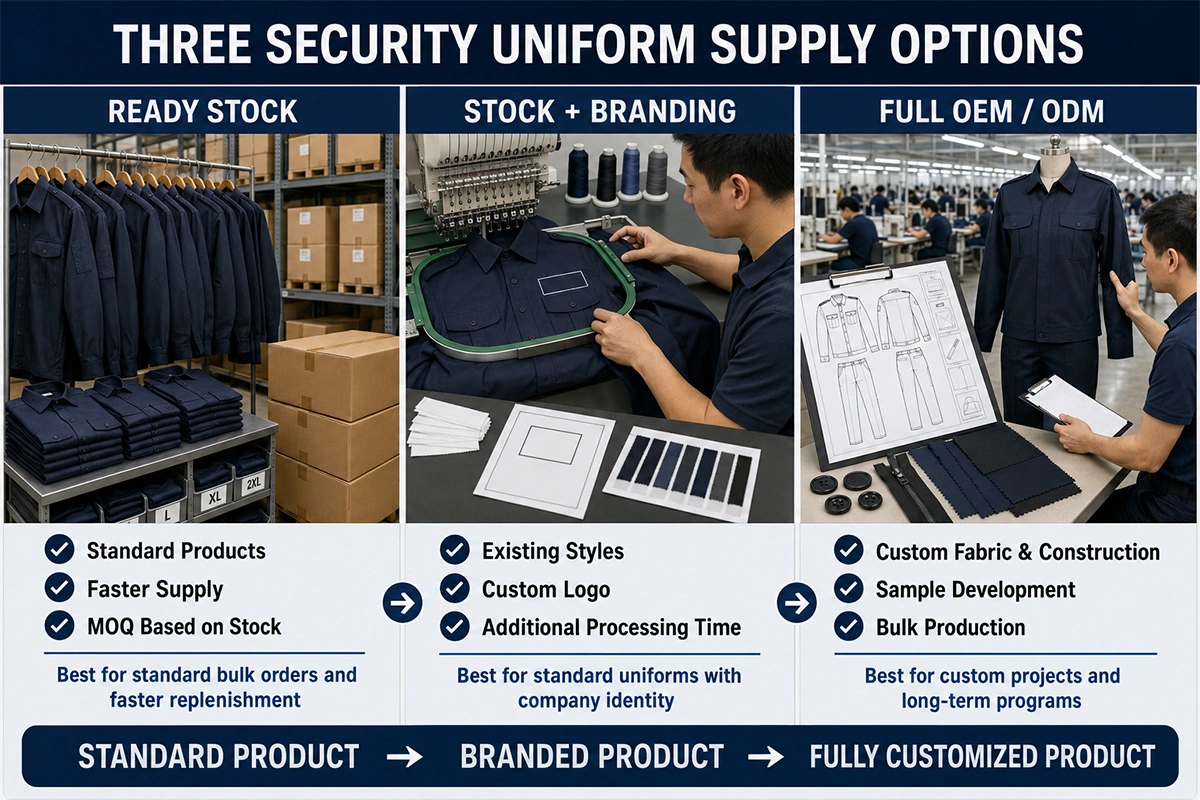
Choosing the right security uniform supplier requires more than comparing unit prices. A suitable supplier also has to match your order quantity, sizing requirements, level of customization, delivery deadline, quality standards, and future reorder needs. A company ordering standard uniforms in bulk may be well served by ready stock. A company that wants a consistent, branded look across its guards will usually need stock uniforms with logo work added. A buyer with a specific fabric, color or construction requirement — for example, a corporate contract or project order with detailed specifications — will typically need full OEM/ODM production.
In security uniform sourcing, the most suitable supply model usually depends on order volume, delivery schedule and the level of customization required. This guide explains how to compare ready-stock, branding and OEM/ODM supply options, and how to evaluate a supplier before placing a bulk order. It is intended for companies, distributors and project buyers purchasing security uniforms in bulk, rather than individual retail buyers.
1. Define Your Security Uniform Requirements
Before contacting suppliers, it helps to be clear on what your order actually requires. This step is often skipped, and it’s one of the main reasons quotes come back vague.
Identify the Products You Need
Security uniform orders usually involve some combination of:
- Security shirts
- Security trousers
- Security jackets
- Polo shirts
- Reflective vests
- Caps and belts
- Complete security uniform sets
- Summer and winter uniforms
Decide whether you’re ordering individual pieces or full sets, and whether separate configurations are needed for different seasons. For accessories such as caps or belts, confirm with the supplier whether these fall within their current supply capability rather than assuming they are automatically included.
Confirm Quantity and Size Breakdown
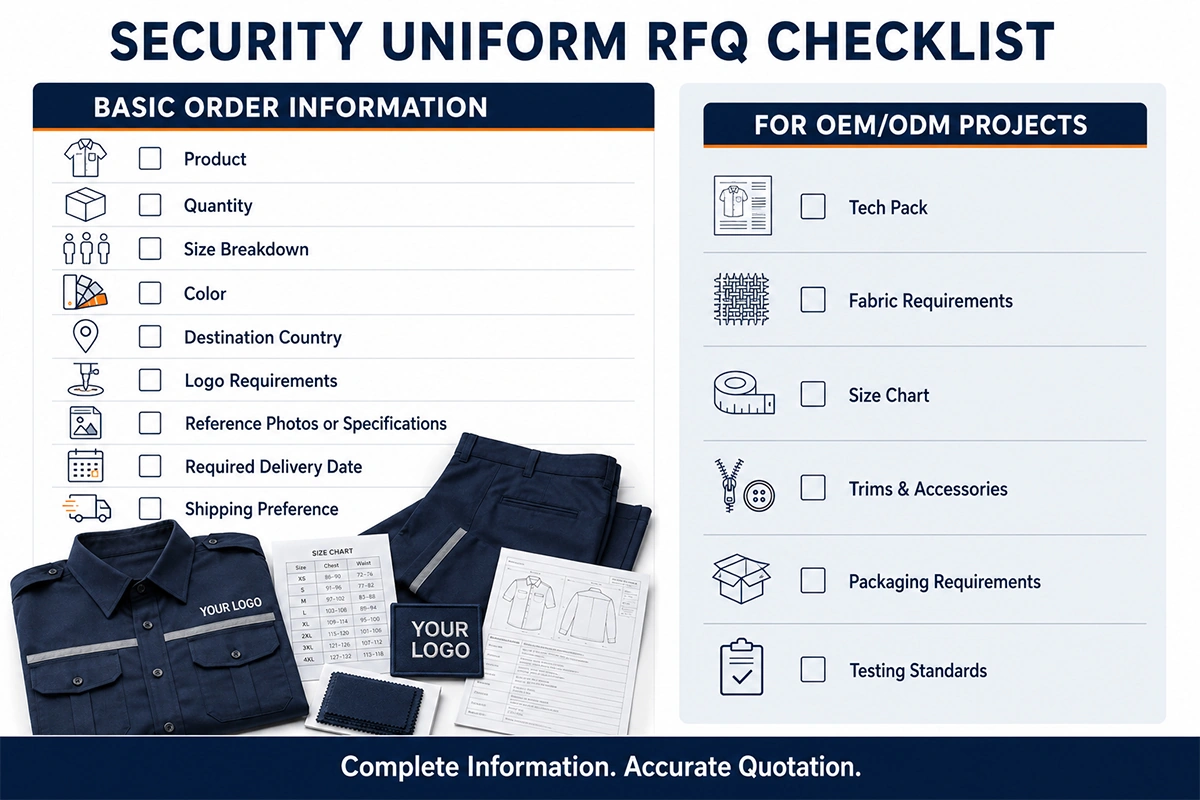
Suppliers need more than a total unit count to provide an accurate quote. Buyers should have ready:
- Total quantity
- Quantity per product
- Size range
- Quantity per size
- Men’s, women’s or unisex requirements
- Whether mixed-size ordering is required
A total quantity without a size breakdown typically results in a preliminary estimate rather than a confirmed price and lead time.
Consider the Working Environment
A few environmental factors will inform the fabric and construction decisions covered later in this guide:
- Indoor or outdoor work
- Hot, humid, cold or rainy climate
- Day or night shifts
- Daily wearing hours
- Office, residential or industrial sites
- Visibility and reflective requirements
Define Delivery and Branding Requirements
Buyers should also confirm:
- Destination country
- Required delivery date
- Logo or patch requirements
- Preferred color
- Reference product or specification
- Whether repeat orders are expected
2. Choose the Right Supply Option
Ready-Stock Security Uniforms
Ready stock is well suited to standard bulk orders, tight deadlines, orders that don’t require changes to the product structure, routine replenishment, and buyers who can work with currently available colors and sizes.
Buyers select from existing styles, lead times are typically shorter, and available colors, sizes and quantities are limited by current inventory. Fabric and construction generally cannot be changed. Ready stock still represents bulk B2B supply — it is not equivalent to retail purchasing.
Ready-stock programs may have lower entry requirements than full custom production, but they remain intended for bulk purchasing. Available styles, colors, sizes and quantities should be confirmed before ordering. Fronter’s ready-stock orders generally start from 100 pieces, subject to current product availability.
This option suits buyers who want to move quickly on standard products, do not need changes to fabric or construction, and require a consistent company identity through branding such as logos, patches or name tapes.
Common branding elements include:
- Embroidered logos
- Printed logos
- Shoulder patches
- Name tapes
- Reflective “SECURITY” wording
- Woven labels
- Custom packaging
Before placing this type of order, buyers should confirm logo artwork, size and placement, color requirements, branding MOQ, any setup or proofing cost, and the additional processing time required. The MOQ for branded stock is not necessarily the same as the MOQ for plain stock — it depends on the branding method and should be confirmed separately.
Full OEM/ODM Production
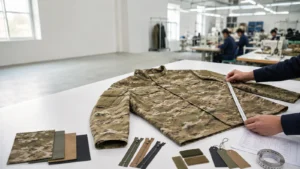
Full OEM/ODM is suited to larger orders, buyers with a specific design or Tech Pack, custom fabric, color or sizing requirements, structural changes such as pockets or reflective elements, branded or contracted projects, and orders that include sample development.
A typical OEM/ODM process includes requirement review, fabric and trim selection, sampling, sample approval, bulk production, quality control, and export coordination. OEM/ODM orders with Fronter generally start from 500 pieces, depending on the product, fabric and customization requirements.
Supply Option Comparison

Exact MOQ and lead time should always be confirmed according to the product, current inventory and customization details.
3. Check Product Availability, Sizing and Repeat Supply
Confirm Current Product Availability
Before committing to an order, buyers should confirm:
- Which styles are currently available
- What colors are available
- The available quantity per style
- Whether real product photos or video can be provided
- Whether the specification matches the quotation
- Whether current stock covers the full required size run
Stock availability should be confirmed at the time of order rather than assumed from earlier communication or website listings.
Review the Size Chart
Size labels such as S, M, L and XL are not standardized across suppliers. Buyers should instead confirm the available size range, actual garment measurements, the measurement method used, size tolerance, mixed-size support, plus-size availability, and how men’s and women’s sizing differ — comparing actual measurements rather than relying on labels alone.
Evaluate Repeat-Order Support
Staff turnover and regular wear typically make reordering part of the relationship. Buyers should confirm whether core styles remain in production, whether logo and order records are kept on file, whether future orders can reuse a previously confirmed size chart, and what alternatives exist if a product is updated or discontinued.
Color, fabric and trim consistency between production batches should be checked rather than assumed, since some tolerance between batches is normal and worth confirming in advance.
4. Evaluate Product Quality and Customization Capability
Fabric Performance for Daily Security Work
Given long shift wear, relevant fabric factors include breathability, abrasion resistance, colorfastness, shrinkage, moisture management, ease of washing, and suitability for the local climate.
Common fabric options include:
- Polyester-cotton blends — durability with easy care
- Cotton-rich fabrics — comfort for extended wear
- Ripstop fabrics — added tear resistance
- Stretch fabrics — suited to more active roles
- Moisture-wicking fabrics — suited to hot climates and polo-style products
The appropriate fabric depends on how and where the uniform will be worn, not on any single fabric being universally preferable.
Garment Construction and Workmanship
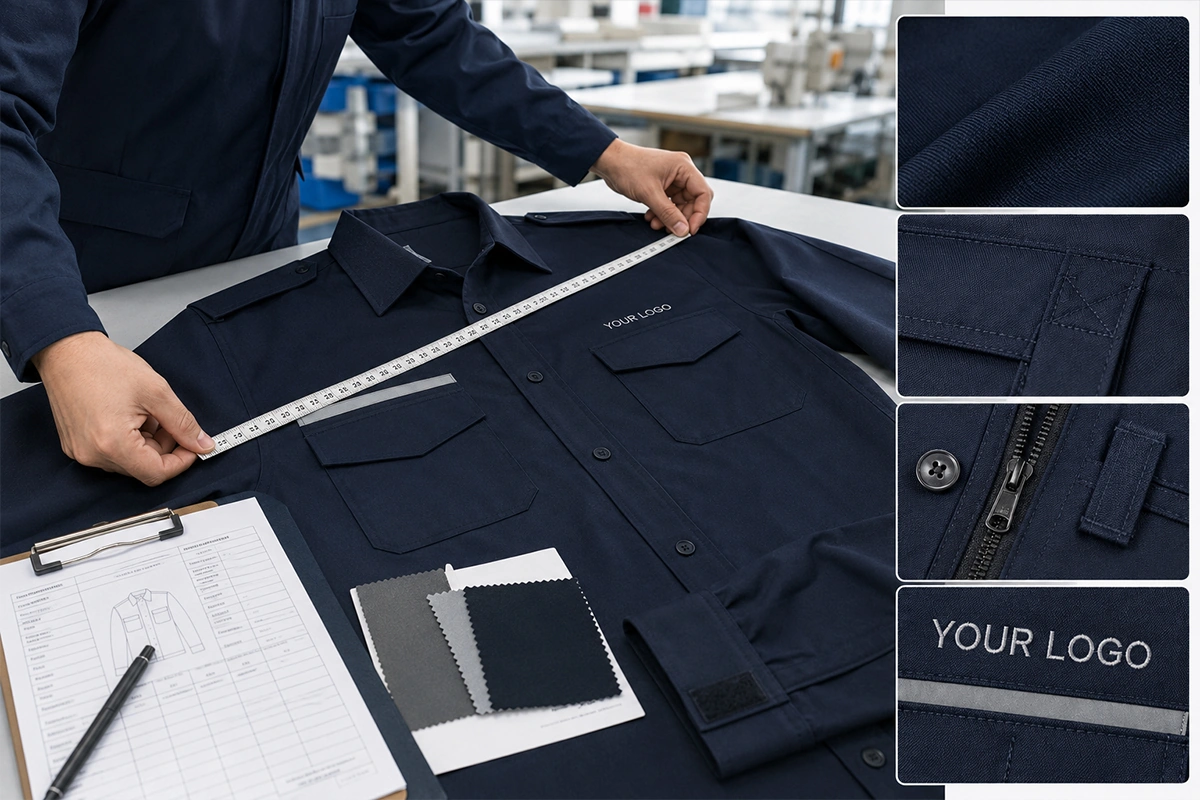
Relevant construction details include stitching consistency, reinforced stress points, pocket construction, zippers and buttons, waistband and belt loops, reflective elements, logo attachment, and overall finishing. Buyers can reasonably request detail photos, product videos, measurement charts, fabric specifications and QC information before confirming an order.
Branding and Customization Capability
Beyond confirming that a supplier can add a logo, buyers should also check:
- Whether the chosen technique is compatible with the fabric
- Whether the logo size and placement are practically achievable
- Whether shoulder patches or reflective wording affect the garment’s structure
- Whether a mockup or confirmation document is provided
- Whether customization requirements are recorded in the order specifications
- How the final result is confirmed before mass production
Sample and Pre-production Approval
For OEM/ODM projects, sample development and approval are normally completed before bulk production. For ready-stock orders, buyers should first review actual product photos, videos, size charts and available specifications. Physical sample availability for stock orders should be confirmed case by case.
5. Compare MOQ, Pricing and Delivery Time
Understand Different MOQ Requirements
MOQ varies by supply model and customization requirement. Ready stock, branded stock and full OEM/ODM may have different thresholds, while special colors, logo methods, fabrics and accessories may also involve separate minimum quantities.
Ready-stock orders generally start from 100 pieces; for uniform sets, the applicable MOQ should be confirmed according to the product combination. OEM/ODM production generally starts from 500 pieces. Actual figures depend on the product, inventory, fabric and customization involved, and should be treated as reference points rather than fixed industry standards.
Understand What Affects Pricing
Pricing is shaped by product style, fabric, order quantity, size breakdown, logo method, reflective elements, trims, packaging, destination country, shipping method, and trade terms. A message that only asks “how much?” will not produce an accurate quote — providing these details upfront leads to a faster, more reliable response.
Compare the Complete Delivery Timeline
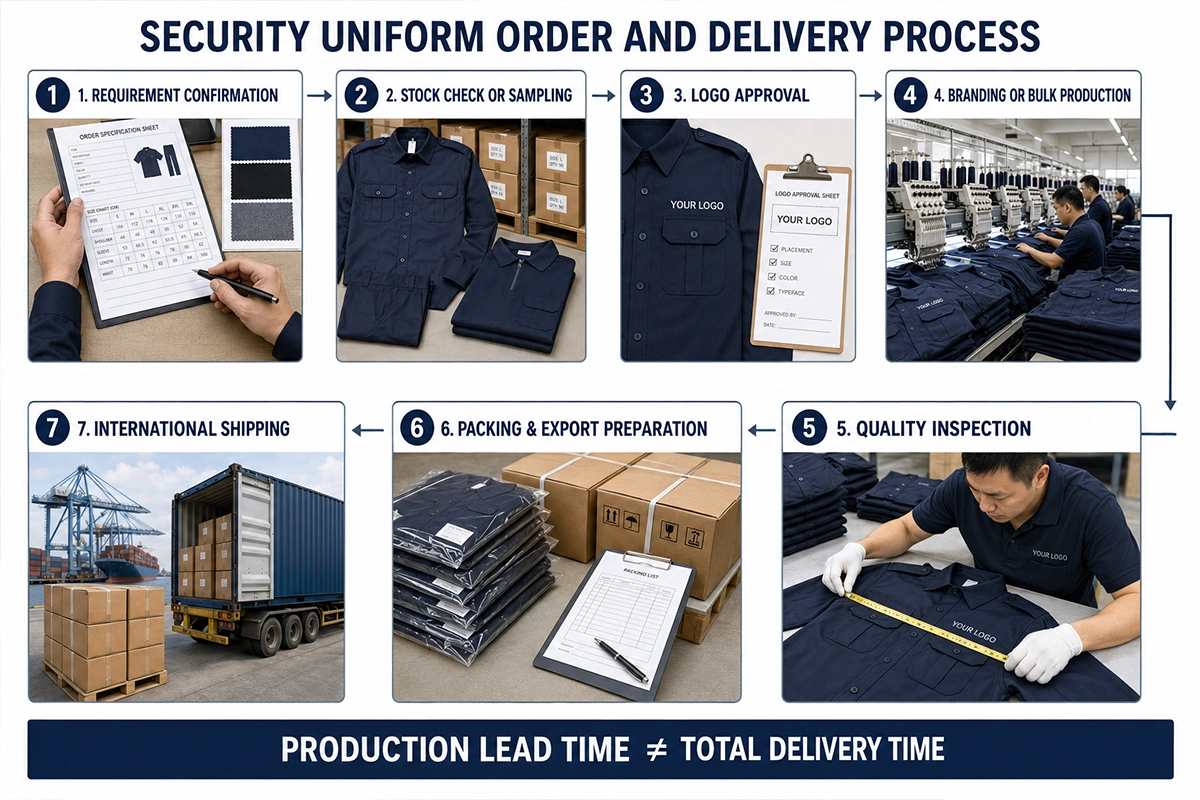
A complete timeline includes stock or sample confirmation, branding or production time, quality inspection and packing, export preparation, and international transit.
Production lead time and total delivery time are not the same. Buyers should confirm whether a quoted date refers to the ready-to-ship date, the estimated departure date, or the estimated arrival date.
Compare Total Order Value, Not Only Unit Price
Beyond unit price, buyers should consider logo costs, sampling, packaging, shipping, import-related expenses, potential quality issues and future reorder costs. Destination country and trade terms affect total cost and are worth confirming alongside the unit price.
6. Verify Supplier Reliability and Avoid Common Risks
Check Company and Manufacturing Information
Worth verifying: company registration, factory or operating address, official website and email, main product categories, factory and production images, export experience, quality control process, and relevant certificates or audit reports.
Certificates should be checked for authenticity, validity period, issuing body, and actual scope. A certification badge on a website is a starting point for verification, not proof on its own.
Evaluate Communication Quality
A reliable supplier will proactively confirm:
- Product
- Quantity
- Size breakdown
- Color
- Logo requirements
- Destination
- Required delivery time
Buyers should also note whether replies are specific and consistent across messages, whether the supplier flags requirements that cannot be met, and whether a clear quotation and order document is provided.
Understand Quality Control and After-Sales Handling
Before ordering, buyers should confirm:
- Whether goods are inspected before shipment
- How quantity and sizing are verified
- How logos and packaging are checked
- Whether inspection or packing records are kept
- What evidence is needed if a problem arises
- Who is responsible for following up on quality issues
Common Warning Signs
Buyers should treat the following as reasons for a follow-up question rather than an immediate conclusion:
- A “final” price is given before product, quantity and destination are confirmed
- Every style, color and size is claimed to always be in stock
- No real product information or size chart can be provided
- Product specifications, company name or payment details are inconsistent
- Branding work begins before logo files, size and placement are confirmed
- Unrealistic lead times are promised for complex customization
7. Send Complete Information for an Accurate Quotation
Information the Supplier Needs
To receive a reliable quotation, buyers should provide the required product, total quantity, size breakdown, preferred color, destination country, logo requirements, reference photos, required delivery date, and preferred shipping method if known. For OEM/ODM projects, it also helps to share a Tech Pack, fabric requirements, trim specifications, packaging requirements, and any quality or testing standards.
RFQ Example
For a ready-stock order with logo customization:
We need 100 navy blue security uniform sets, each including one short-sleeve shirt and one pair of trousers. Sizes will be mixed from S to 3XL. We would like to add an embroidered company logo on the left chest. The goods will be shipped to Johannesburg, South Africa. Please confirm product availability, size options, branding requirements, estimated cost and delivery time.
For a full OEM/ODM order:
We are planning an order of 1,000 custom security uniform sets. We require long-sleeve shirts and trousers in navy blue, with embroidered chest logos, shoulder patches and reflective SECURITY wording. We have a reference design and size chart. Please advise on fabric options, sample development, MOQ, production lead time and shipping to Nairobi, Kenya.
Final Checklist for Choosing a Security Uniform Supplier
- The supply option matches your order requirements
- The MOQ is suitable for your purchasing volume
- Available styles, colors and sizes have been confirmed
- Fabric and workmanship meet the working conditions
- Logo and customization details are documented
- Pricing and trade terms are transparent
- The delivery schedule is realistic
- The supplier can support quality control and future orders
Conclusion
For standard uniforms in bulk or a fast reorder, ready stock is the appropriate starting point. For orders that can use existing styles but require a consistent company identity, stock with logo customization is the better fit. For orders requiring a specific fabric, color, structure or long-term supply program, full OEM/ODM is the appropriate route. The right supplier should match your purchasing volume, quality requirements, customization needs and delivery schedule — not simply offer the lowest unit price.
Looking for a reliable B2B security uniform supplier? Send us your product requirements, quantity, size breakdown, destination and customization details. Fronter will recommend a suitable ready-stock, branding or OEM/ODM solution for your bulk order.
Ready-stock orders generally start from 100 pieces, while OEM/ODM production generally starts from 500 pieces. Actual requirements depend on the product and customization details.
Request a Bulk Quotation
FAQ
Q1: What is the MOQ for security uniforms?
A: MOQ depends on the supply method. Fronter’s ready stock typically starts from 100 pieces, and OEM/ODM typically starts from 500 pieces.
Q2: Can I order mixed sizes?
A: Yes, based on a size breakdown confirmed against current stock or production scheduling.
Q3: Can a logo be added to stock security uniforms?
A: Yes, through embroidery, printing, patches, name tapes or reflective wording. This may involve a separate MOQ, a setup fee and additional processing time.
Q4: Do you provide samples for security uniform orders?
A: OEM/ODM projects normally include sample development before bulk production. For ready-stock orders, physical sample availability depends on the specific product and order.
Q5: How long does production and delivery take?
A: This depends on stock or sample confirmation, branding or production time, inspection and packing, and transit time. An accurate timeline is confirmed once the product, quantity and destination are known.
This depends on stock confirmation, logo processing, sample development (where applicable), bulk production, inspection and packing, and international transit. An accurate delivery timeline can only be confirmed once the product, quantity, customization and destination are known.